News
Highlights from the 3rd TWIN-RELECT Training School
On January 14–16, 2026, the 3rd TWIN-RELECT Training School successfully brought together students, professors, and experts to explore the future of Fault-Tolerant AI Systems. Hosted by the University of Manchester, the event combined technical innovation with essential professional skills.
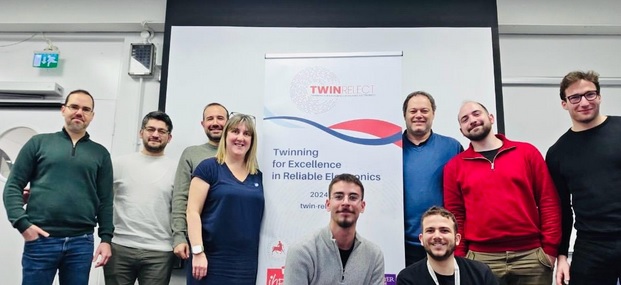
Building on this vision, the three-day programme offered a balanced mix of advanced technical lectures, hands-on sessions, facility visits, and interactive workshops. Participants gained in-depth exposure to reliability-aware design, verification, and testing techniques for modern AI and neuromorphic systems, while also developing transferable skills essential for interdisciplinary research and collaboration.
A big thanks to Davide Bertozzi, who organized this extraordinary event, coordinating a diverse and high-quality programme that combined cutting-edge research topics with practical training and development. We would also like to warmly thank all the invited speakers and instructors for sharing their expertise, insights, and enthusiasm, which were instrumental in the success of the training school.
Event Highlights:- Reliability & Testing: We opened with insights into neutron beam testing for safety-critical electronics, presented by Carlo Cazzaniga (Rutherford Appleton Laboratory), who introduced irradiation-based reliability assessment and its role in validating dependable electronic systems. This was complemented by technical sessions on fault analysis and verification, followed by hands-on fault simulation activities using the EMBER tool, allowing participants to experiment directly with fault injection and tolerance techniques.
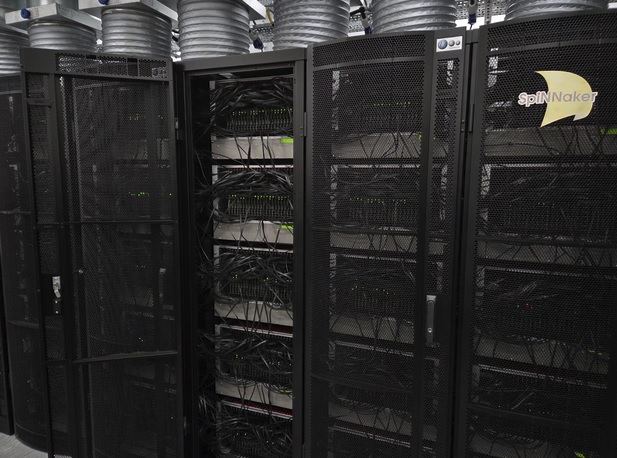
- Neuromorphic Computing: Day 2 featured the University of Manchester’s APT group, covering Spiking Neural Networks (SNNs). Participants also visited the large-scale SpiNNaker machine. Haralampos Stratigopoulos (Sorbonne Université) delivered a keynote on reliable AI hardware, highlighting challenges and solutions for ensuring robustness in emerging AI accelerators and neuromorphic systems.
- Leadership & Skills: The final day focused on team collaboration and professional skills through interactive workshops aimed at enhancing communication, teamwork, and leadership in research environments. The programme concluded with an inspiring talk by Steve Furber, principal designer of the ARM microprocessor, who shared technical and leadership lessons from the development of the SpiNNaker system, offering valuable perspectives on managing large-scale, high-impact research projects.
We would like to thank our colleagues from the AIDA4EDGE and TAICHIP twinning projects who participated in our event. Their presence initiated productive discussions on shared research challenges, synergies, and future collaboration opportunities, reinforcing the broader impact of the TWIN-RELECT initiative and strengthening connections across European research efforts in dependable and fault-tolerant AI systems.